
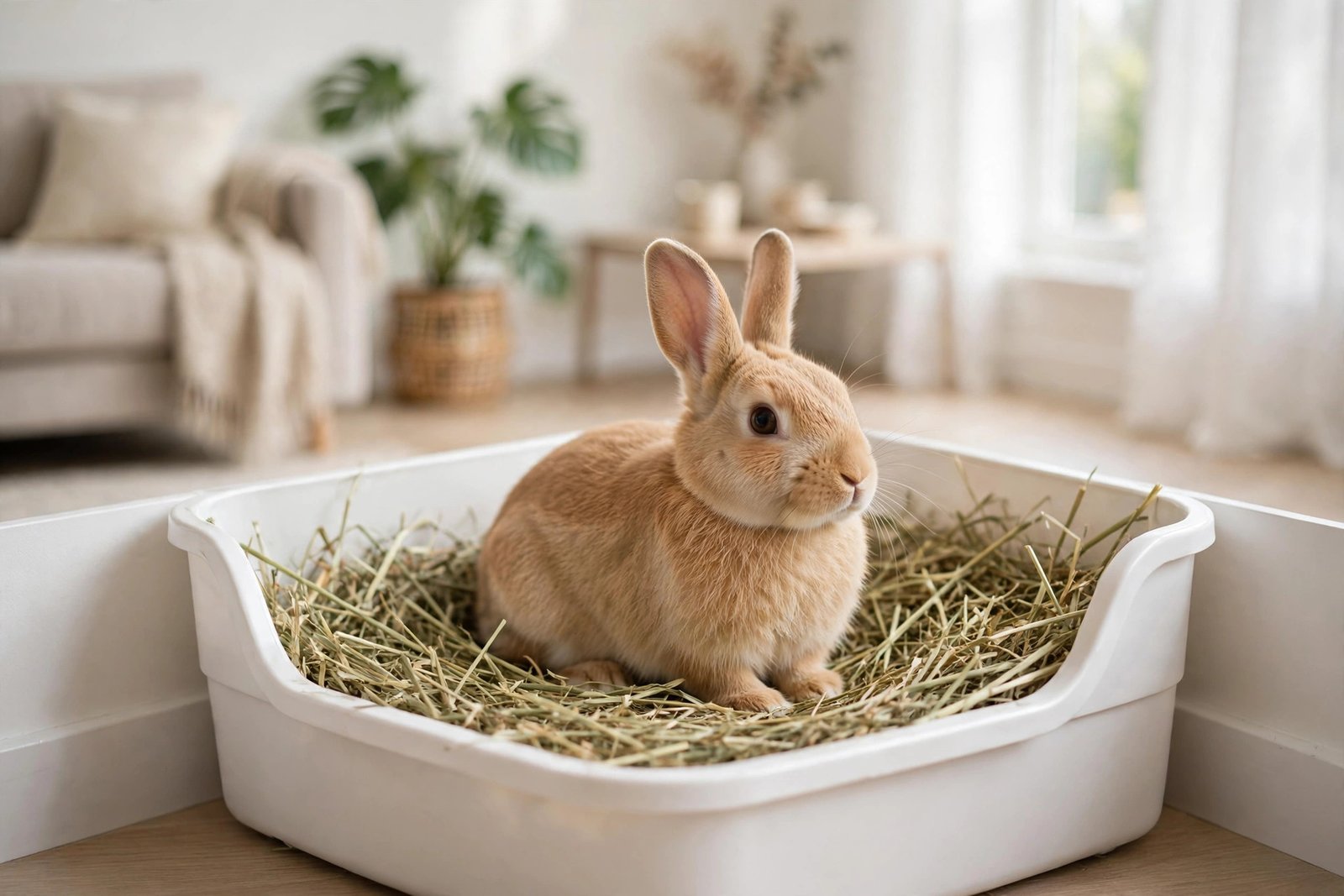
If you have ever swept up a trail of dry pellets for the third time before breakfast, you have probably wondered how to potty train a rabbit — and whether it is even possible. The good news: it is one of the easiest parts of rabbit care. Rabbits are naturally clean animals, and most already pick one or two favourite corners for the toilet. To litter train a rabbit, you do not teach a brand-new behaviour — you put a litter box where your bunny already wants to go. Most house rabbits learn reliable habits in one to two weeks; unaltered and older rabbits may need three to four.
Can Rabbits Be Litter Trained?
Yes — the House Rabbit Society, the RSPCA and the Rabbit Welfare Association all say so. A rabbit does not scatter droppings at random: it chooses a quiet corner and returns to it. Your job is to notice that corner and place the tray there.
Set honest expectations first: a spayed or neutered rabbit uses the box for roughly 90 to 95 percent of its toileting; the rest is usually a few dry territorial pellets — easy to sweep up, not a failure. An unaltered rabbit, especially a male over four months, is different: hormones drive urine spraying and scattered droppings, so reliability sits near 60 to 70 percent even with good training. As the House Rabbit Society puts it, rabbits will never have 100 percent perfect litter habits — and that is fine. A litter-trained bunny is a far cleaner housemate, and the box lets you watch droppings and urine — an early window into its health.
What You Need to Litter Train a Rabbit
You do not need expensive equipment — a basic setup costs very little.
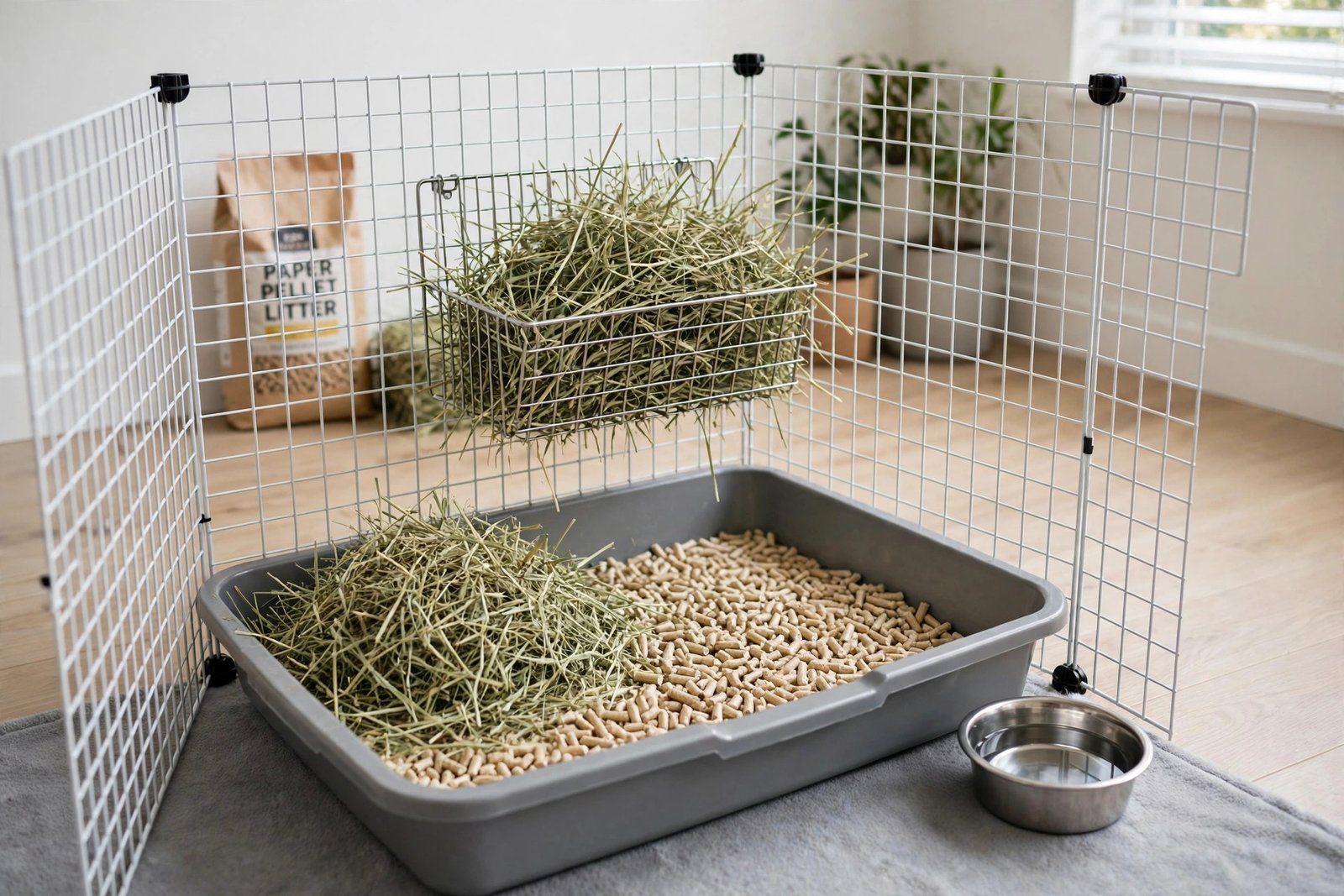
- A litter box your rabbit can sit in with all four feet inside, turn around, and lie down: 9 by 12 inches for a small rabbit, 14 by 10 inches for standard breeds, 15 by 18 inches for a pair or a large breed such as a Flemish Giant. Low sides help young, old or arthritic rabbits hop in and out.
- Safe litter, one to two inches deep — paper pellets and kiln-dried pine pellets are the standard choices (see below).
- Plenty of timothy hay: a handful in the box, plus a hay rack above or beside it. Rabbits eat and eliminate at the same time, so hay is your best training tool — and the bulk of their diet; see our guide on what rabbits eat for the balance of hay, pellets and greens.
- A small space to start in: the rabbit’s enclosure or one section of an exercise pen.
- A litter scoop, white vinegar and water, and parsley or basil treats for rewards. A second box for the free-roam area is useful, as is a high-sided box for litter-kickers.
Best Litter for Rabbits
Choosing the best litter for rabbits is mostly about safety: rabbits nibble their litter, and the wrong product can block a gut or damage delicate lungs.
| Litter type | Safe? | Odour control |
|---|---|---|
| Paper-based pellets | Yes | Good |
| Kiln-dried pine pellets | Yes | Excellent |
| Aspen shavings | Yes | Fair |
| Clumping clay cat litter | NO — fatal blockage if eaten | Excellent |
| Cedar shavings | NO — toxic aromatic oils | Good |
| Corn cob litter | NO — moulds, blocks the gut | Poor |
| Scented or crystal litter | NO — dust and chemicals irritate lungs | Good |
Paper pellets are the safest all-round choice: absorbent, low dust, harmless if nibbled. Kiln-dried pine pellets control odour better and cost less — but the bag must say kiln-dried, as raw pine and cedar release phenols that harm a rabbit’s liver and airways. If your rabbit eats more than a nibble, switch products or line the box with newspaper and hay. Never use cat litter for a rabbit: most of it is toxic to them.
How to Litter Train a Rabbit Step by Step
Here is the method rabbit rescues and veterinarians recommend.
Step 1: Find the toilet corner
For a day or two, watch where your rabbit urinates — the pen corner, behind furniture, or along a wall. That is where the box goes. Putting it where you want it instead of where the rabbit goes is the most common reason training fails.
Step 2: Start in a small space
Confine the rabbit to its enclosure or a small pen section, box in the chosen corner — most rabbits start within 24 to 48 hours. Put hay in the box, plus a few of the rabbit’s own droppings and a paper towel dabbed in its urine. The familiar scent says “this is the bathroom.”
Step 3: Reward the box, never punish accidents
When your rabbit uses the box, offer a tiny treat or praise straight away. Never shout at, chase, tap or punish a rabbit for an accident: punishment creates fear, and a frightened rabbit hides, stops eating, and trains far more slowly. Never grab a rabbit out of its box — it should feel like safe territory, not a trap.
Step 4: Clean accidents the right way
Scoop once or twice a day, moving stray droppings into the box. Blot urine with a paper towel, put the towel in the box, then clean the spot with half white vinegar, half water. Never use ammonia cleaners — ammonia smells like urine to a rabbit and invites it back. For carpet, an enzyme cleaner works best. When you deep-clean, leave a little used litter behind — its faint scent says “bathroom” to your rabbit.
Step 5: Expand slowly, then keep the routine
Once the rabbit uses the box reliably for a few days, open up more of the pen or room. If it returns to the box, training is holding; if it picks a new corner, put a second box there. Expand room by room, keep the rabbit enclosed when unsupervised, and keep beds and sofas off-limits until neutering. Then scoop daily, deep-clean weekly, and top up the hay — a rabbit that finds a dirty box will choose the clean floor. Never clean the box while your rabbit is inside. When one box is used consistently for a week, remove the second — unless your rabbit has settled on two permanent corners, which is normal.
Your Two-Week Plan: What to Expect
Days 1 to 3, confined space, box in the preferred corner: expect 60 to 70 percent of droppings in the box, with some urine accidents normal. Days 4 to 7, expanded space: box use should reach 80 to 90 percent for urine and 70 to 80 percent for droppings. Weeks 2 to 3, full room access if rabbit-proofed: use stabilises at 90 to 95 percent for altered rabbits and 70 to 80 percent for unaltered ones, and what remains is almost always dry pellets; further improvement needs spaying or neutering, not more training. If box use drops below half after being at 80 percent, shrink the space back and restart — most regressions fix within three to five days.
Baby, Older and Free-Roam Rabbits
Wondering how to litter train a bunny? Start as soon as you bring it home — young rabbits usually adjust fastest. But a rabbit under six weeks old will not be reliable, and even a weaned baby has a small bladder and a short attention span, so expect more accidents and keep the space small for longer. The turning point is four to six months, when a rabbit can be spayed or neutered; until then, focus on the habit, not perfection.
Older rabbits can learn too — allow extra weeks and use a low-entry box, since arthritis makes high sides painful. If a previously reliable older rabbit suddenly stops using the box, that is a vet visit: pain, bladder sludge and kidney issues show up first as toileting changes. A free-roam house rabbit can be trained just as reliably, but it needs a box in every room it can reach at the start, in the corner it has already chosen there. Rabbit-proof each room first — cover cables, block gaps, remove toxic houseplants — and keep the rabbit out of bedrooms until the habit is set, because beds are a favourite marking target.
Does Spaying or Neutering Help?
Enormously — the single biggest factor after box placement. An unaltered rabbit, especially a male over four months old, sprays urine on vertical surfaces and scatters droppings to mark territory. These are hormonal behaviours, not hygiene failures, and no training overrides the drive to scent-mark. Spaying or neutering removes that drive within four to six weeks, and reliability typically jumps from 60 to 70 percent to 90 to 95 percent. It also brings health benefits, including a much lower risk of uterine cancer in females.
Troubleshooting: When Training Goes Backwards
A trained rabbit that suddenly stops using its box is usually telling you something. First check the obvious: is the box dirty, too small, or has it moved? Has something stressful happened — a new pet, a house move, building noise? Fix the setup and shrink the space for a few days.
A rabbit that strains to urinate, passes very small droppings, stops eating, or sits hunched and quiet may be developing gut stasis, a urinary infection or bladder sludge — all urgent, needing a vet the same day. A rabbit that trembles or shakes while toileting may be in pain; our guide on why rabbits shake explains the warning signs. One that starts urinating on beds is often marking after a household change, or it may have sore hocks or an arthritic hip — a lower-entry box and a vet check solve both. A rabbit that kicks litter out needs a high-sided box; one that sleeps in its box is simply comfortable there. Mistakes to avoid: putting the box where it looks tidy, using a box that is too small, cleaning away all scent, punishing accidents, and changing litter, box and location at once.
Frequently Asked Questions
How long until my rabbit is fully litter trained?
Most rabbits develop reliable habits within one to two weeks; unaltered and older rabbits may take three to four, and may never reach 100 percent.
Are male or female rabbits easier to potty train?
Females are usually slightly easier, as males spray and scatter more — but spaying or neutering matters far more than sex.
Can you potty train a rabbit that is not spayed or neutered?
Yes, but expect a longer process and more stray pellets. The habit still forms, and training usually improves dramatically after the rabbit is altered.
Why does my rabbit poop outside the litter box?
Scattered dry pellets are usually territorial marking — neutering reduces them by 80 to 90 percent. Wet accidents usually mean the box is too dirty, too small, or in the wrong place: clean daily, size up the box, and move it to the corner your rabbit uses.
The Bottom Line
Learning how to potty train a rabbit means working with your bunny’s instincts: put the box in the corner your rabbit chose, fill it with safe litter and fresh hay, start small and expand slowly, reward every success, and let spaying or neutering do the heavy lifting on hormones. In one to two weeks most rabbits use their box reliably — and the few stray pellets that remain are a small price for a clean house and a happy rabbit. A rabbit that uses its box eagerly, eats well and moves freely is a content rabbit — watch for the joyful twist in the air owners call a binky, explained in our guide on why rabbits binky.
