
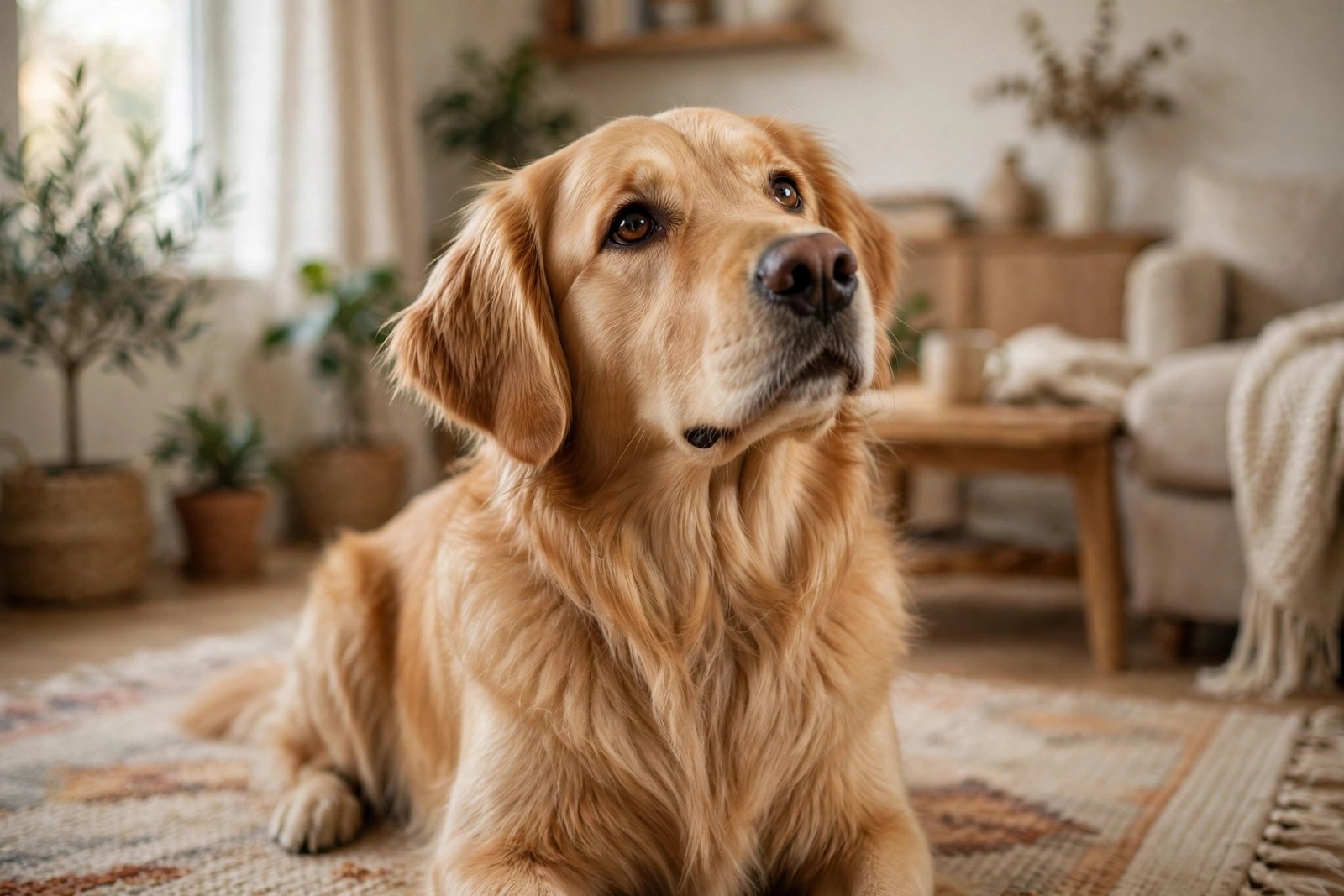
You look up from your dinner plate — and there it is: two eyes, locked on you. If you have caught yourself thinking, why is my dog staring at me, you are not alone: millions of owners ask the same thing. Most staring is harmless — dogs cannot talk, so their eyes do the talking.
Why Is My Dog Staring at Me? The Short Answer
A stare can mean love, hunger, a question, worry, or a warning — and the meaning sits in the rest of the face. Soft, squinty eyes with a loose body mean affection. A bright, alert stare with ears forward usually means “I want something.” A hard, unblinking stare with a stiff body is a warning. Most home staring is a request or attachment. The one stare to take seriously: a dog that suddenly starts gazing at walls or into empty space may be unwell.
The Stare Decoder: Read the Whole Face First
Never judge a stare by the eyes alone — check eyes, ears, mouth and body first.
| Stare | Eyes | Ears and body | It usually means | Do this |
|---|---|---|---|---|
| Soft, squinty gaze | Relaxed, half-closed | Ears neutral, loose body | Affection, contentment | Talk softly |
| Bright, alert stare | Wide, focused | Ears forward, tail up | “I want something” | Check food, door, toy |
| Shifty, flicking gaze | Darting, looking away | Low body, tucked tail | Worry or confusion | Give space |
| Hard, fixed stare | Unblinking, wide pupils | Ears pinned, stiff, still | Warning, guarding, fear | Back away slowly |
| Blank, glassy stare | Unfocused, staring through you | Still, slow to respond | Pain, illness, confusion | Call the vet |
Why Does My Dog Look at Me? 9 Meanings
Most stares mix two or three of these meanings, and when you ask why does my dog look at me that way, one of these nine is usually the answer.
1. Affection — the Oxytocin Gaze
This is the stare most owners hope for, and science backs it up: a 2015 Science study found mutual gazing between dog and owner raises oxytocin, the bonding hormone, in both. It is a big part of why do dogs stare at their owners with soft, squinty eyes. Dogs love being petted in these moments.
2. They Want Something
Dogs learn fast that eye contact gets results. Around mealtimes, many catch your eye to remind you dinner is due. Others stare, then glance at the door, the leash hook, or the treat jar — the dog pointing with its eyes. It is a big part of why do dogs stare at you the moment you stand up: the thing your dog keeps looking at is usually the thing it wants.
3. They Want to Play
A stare with a toy in the mouth, or one that ends in a play bow, is an invitation, not a mystery. It often comes with a wagging tail and a toy dropped hopefully at your feet. If you have five minutes, take the offer: a short game of fetch or tug burns off the energy behind the stare.
4. They Are Confused and Waiting for a Cue
Dogs look to us for instructions. If a command confused your dog, or it walked into an unfamiliar situation, it will stare at you for clarity — sometimes tilting its head as it tries to work out what you want. This is a thinking stare, not a demanding one. Repeat the cue once, calmly, or show the dog with a hand signal.
5. They Are Reading Your Mood
Dogs are expert watchers of human faces. They learn your routines, tone, and body language, and check in constantly. Many stare more when their owner is sad or upset, moving closer to comfort them. They also time requests cleverly, asking for attention when you look relaxed and keeping away when you look tense.
6. They Are Worried or Anxious
A nervous dog watches its owner like a worried child watches a parent. Dogs with separation anxiety often stare constantly, afraid you will slip out and leave. The stare looks different: low body, tucked tail, eyes flicking to the exit. If the anxious staring is daily and intense, ask your vet about calming routines or pheromone diffusers.
7. They Are Guarding Something
A dog staring over a chew, a food bowl, or a favourite resting spot may be guarding it. This stare is hard and still, with a stiff body and a closed mouth — the dog is telling you, or another pet, to keep away. Do not reach for the guarded item and do not punish the stare: both can make guarding worse. Trade for something better instead, and ask a trainer if it is a regular pattern.
8. They Feel Threatened — the Warning Stare
In the animal world, a direct hard stare is a threat display, used with strangers, unfamiliar dogs, and anyone who corners them. The body goes stiff, the ears pin back, the mouth closes tight, and the eyes do not blink. Respect it immediately: look away and move away slowly. Never hold a strange dog’s gaze, and never stare a dog down to “show dominance” — it reads as a challenge.
9. They Don’t Feel Well
Sometimes a stare is a plea: a dog in pain, feeling sick, or suddenly confused will fix its eyes on its owner, hoping you notice. This is another reason why do dogs stare at their owners so intently at odd moments: you are the one person they trust to help. If the stare comes with glassy eyes, low energy, or a reluctance to move, call the vet if anything seems off.
Why Does My Dog Stare at Me When I Eat?
The mealtime stare is the most rewarded stare in a dog’s life. Every scrap slipped from a plate teaches the dog that staring at a human who is eating pays off. It usually comes with lip licking and eyes that follow every bite from plate to mouth. Why does my dog stare at me when i eat so intensely? Because it has worked before, probably many times. To break the habit, feed your dog before your own meal, never hand food from the table, and reward calm lying-down instead — and expect the staring to get worse for a few days first, which is normal before a habit fades.
Why Does My Dog Stare at the Wall?
A dog gazing at a blank wall looks strange, and owners worry first about what the dog can see that they cannot. Often the answer is ordinary: dogs hear far better than we do, and a noise inside the wall — pipes, insects, a mouse — can hold their attention for minutes.

But sudden wall staring deserves attention. In a senior dog, staring at walls or corners can be an early sign of canine cognitive dysfunction — the dog equivalent of dementia — especially with disorientation or forgotten house training. A focal seizure can do the same, leaving the dog briefly blank and unresponsive. Why does my dog stare at the wall every evening all of a sudden? If the behaviour is new, frequent, or paired with any other change, film a short clip and show your vet — a single curious look is nothing, but a new daily ritual is a check-up.
Why Does My Dog Stare at Nothing?
Staring into empty space follows the same logic as wall staring. A dog in a why does my dog stare at nothing moment is often just lost in thought — tracking a faint sound or watching dust in a sunbeam. Owners who ask why does my dog stare into space usually get a reassuring answer: most of the time it is nothing at all. If you keep asking why does my dog stare into space, watch what else changes: a dog that also circles, gets stuck, or fails to recognise familiar people may be showing early cognitive decline. Occasional space-staring in a bright, active dog is normal; daily episodes plus confusion are a vet visit.
Why Does My Dog Stare at Me When I Sleep?
Waking up to two eyes watching you in the dark is unsettling, but the reason is usually sweet: your dog is checking you are still there. Dogs are social sleepers, and many keep a light watch over their people at night — part guardian, part worry that you might leave. Why does my dog stare at me when i sleep every night? Look at the rest of the night: a dog that settles back down quickly is fine, while one that paces or pants may be anxious. Dogs change sleeping positions through the night, so a brief watchful moment is normal. If the night staring is new and restless, mention it at your next vet visit.
Why Does My Dog Stare at Me So Much?
Some dogs are simply watchers: they follow you from room to room, and owners often ask why does my dog stare at me so much when the attention never seems to switch off. Part of the answer is breeding: herding dogs such as Border Collies and Australian Shepherds were bred for “the eye,” a fixed gaze used to control sheep, and they aim it at their owners too. Why do dogs stare at you so constantly also comes down to reinforcement: every stare that earned a treat, a walk, or a cuddle made the habit stronger. Constant staring is not a problem on its own, but if it comes with whining or pacing, give your dog more to do — training games and puzzle feeders tire out a busy mind far better than scolding will.
What NOT to Do When Your Dog Stares
- Never stare back at a strange or stiff dog — it reads as a threat and can provoke a bite.
- Never punish the stare itself: it teaches your dog to hide the warning signs, not to feel safer.
- Never reward begging inconsistently: giving in “just this once” teaches your dog that staring longer eventually works.
When to Call the Vet
Most staring needs no vet at all — but book an appointment if you see any of these:
- The staring started suddenly in a dog that never did it before
- Glassy, unfocused eyes, or a dog that stares through you
- Circling, head pressing, or getting stuck behind furniture
- Disorientation, personality changes, or forgetting familiar people and routines
- Staring paired with sickness signs such as vomiting white foam or lethargy
- A senior dog with new confusion, night restlessness, or house-training accidents
Film a short video before the visit — vets diagnose staring far more easily when they can see it.
Frequently Asked Questions
Is it normal for a dog to stare at its owner?
Yes — staring is normal dog communication. If you keep wondering why is my dog staring at me, the honest answer is usually affection, a request, or curiosity. It only becomes a concern when the stare is hard and stiff, or when a new staring habit appears with other health or behaviour changes.
Should I stare back at my dog?
With your own relaxed dog, a brief soft gaze is fine. Never stare back at a strange or stiff dog: in dog language that is a challenge, and the safe move is to look away and give space.
Why does my dog follow me everywhere and watch me?
Attachment, routine, and habit — dogs are social animals that evolved to track their people, and herding breeds do it most of all. If the shadowing comes with distress when you leave, build independence with short absences and reward calm settling.
The Bottom Line
Your dog’s stare is a message, and most of the time it is a kind one — love, a request, or simple curiosity. Read the whole face, not just the eyes. The one stare that deserves action is the new, blank stare at a wall or into space, especially in a senior dog: film it and call your vet. Everything else is your dog’s way of saying you are the most interesting thing in the room.
