
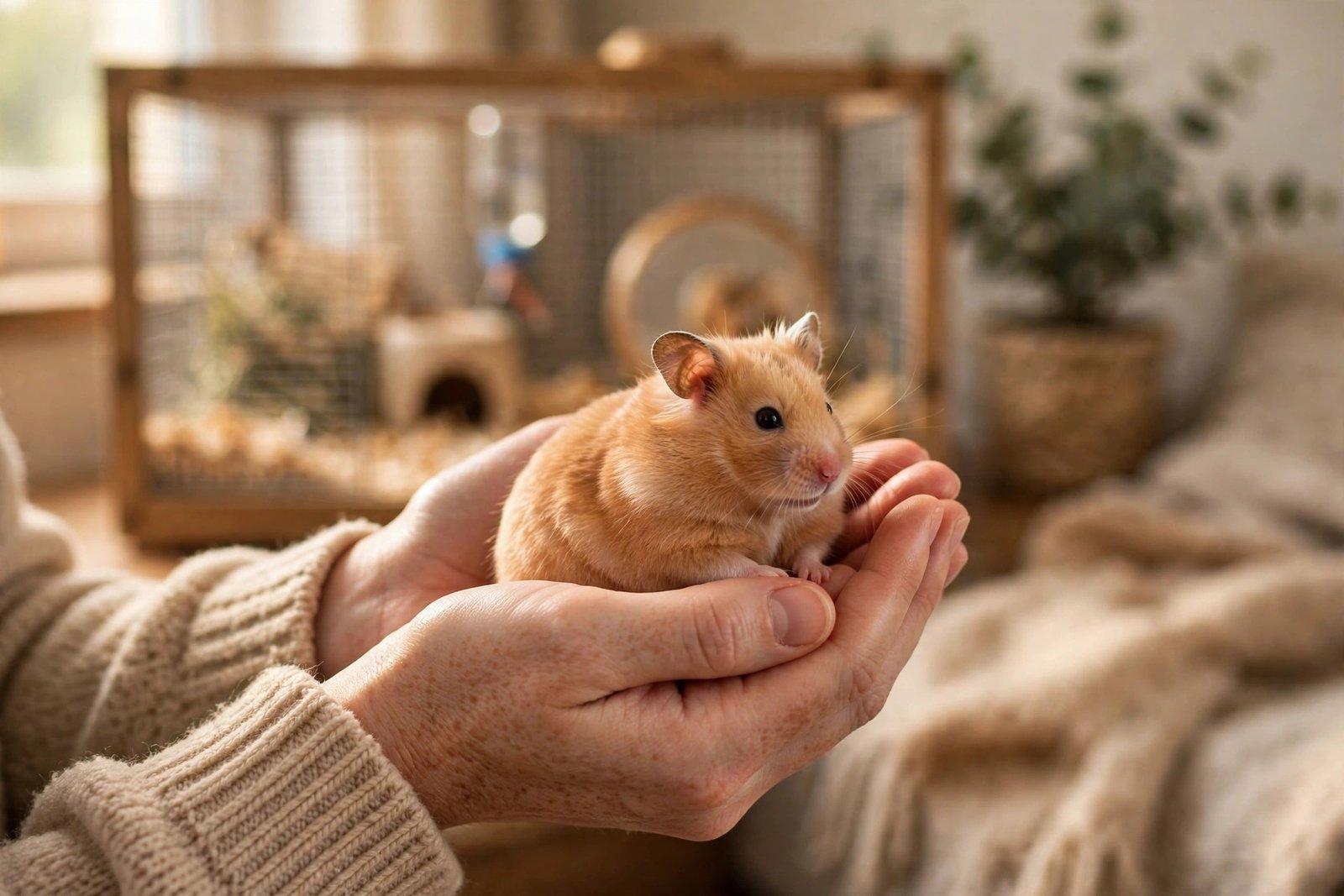
Is Your Hamster Still Scared of You? How to Tame a Hamster in 7 Days
You bring home a tiny ball of fur, open the cage door — and your new hamster bolts for the nearest hideout. A week later it still flinches at your hand, and the first time you try to pick it up, you get a sharp little nip. Learning how to tame a hamster simply takes a slower, gentler approach than most new owners expect, because hamsters are prey animals whose first instinct is to run from anything big — including you. Almost every hamster can learn to trust you within one to two weeks of short, daily sessions.
Why Your Hamster Is Scared of You
In the wild, a hamster is lunch for owls, foxes and snakes, and that prey-animal wiring does not switch off in a pet shop cage. Your hamster sees a giant shape, hears loud sounds and smells unfamiliar scents — and its brain says “danger”. Three facts explain nearly all shy hamster behaviour. First, hamsters have poor eyesight: they navigate mostly by smell and by their whiskers, so a hand reaching in from above looks like a predator swooping down. Second, they are crepuscular — most active around dawn and dusk — so a midday cuddle attempt usually means waking a grumpy, half-asleep animal. Third, everything is new: the cage, the bedding, your voice, your scent. Fear is normal, not a sign of a “mean” hamster.
Give Your Hamster 3 Days to Settle In
The single biggest taming mistake is starting too soon. Give your hamster three quiet days before any handling at all.
Keep the cage in a calm spot away from televisions, barking dogs and slamming doors. Talk softly near the cage so your hamster links your voice with safety, and change food and water slowly, with no sudden movements. A proper hamster cage setup with deep bedding, a hideout and a wheel makes settling in much faster, because a hamster that can burrow and hide feels safe enough to relax. The best bedding for hamsters is deep, soft and unscented — aim for at least 15 cm so your pet can dig a proper burrow and build a nest.
What You Need Before Day 1
Taming needs almost no equipment, but the right supplies make every session smoother.
The best treats for hamsters. Small, smelly, high-value foods work best: a sunflower seed, a pumpkin seed, a tiny piece of walnut, a mealworm or a floret of broccoli. Keep pieces tiny, and reserve these treats for taming sessions only, so your hamster connects your hand with the best food in its life.
A scent-soaked tissue. Sleep with a plain tissue in your sleeve or pocket for a night, then leave it in your hamster’s nest. Your pet gets used to your scent while feeling completely safe.
A safe play area. A dry bathtub with a towel on the bottom, or a small playpen, gives you a neutral space for later steps. Block every escape route and remove other pets from the room first.
The 7-Day Plan: How to Tame a Hamster Step by Step
Work in the evening, when your hamster is naturally awake, and keep every session to 5–10 minutes, two or three times a day.
Days 1–2: Scent and voice. Sit beside the cage and talk quietly for a few minutes. Put the scent-soaked tissue in the nest. Do not put your hand inside yet. Goal: your hamster eats and moves around normally while you are nearby.
Day 3: A still hand in the cage. Wash your hands first — food smells invite test bites. Rest your flat, open hand on the cage floor and hold completely still. Let your hamster approach, sniff and walk away. Do not chase it or try to touch it yet.
Day 4: Treats from your palm. Place a sunflower seed on your open palm and wait. Most hamsters will dart in, grab the treat and run — that counts as success. Repeat a few times per session. This is the turning point: your hand is becoming the source of good things.
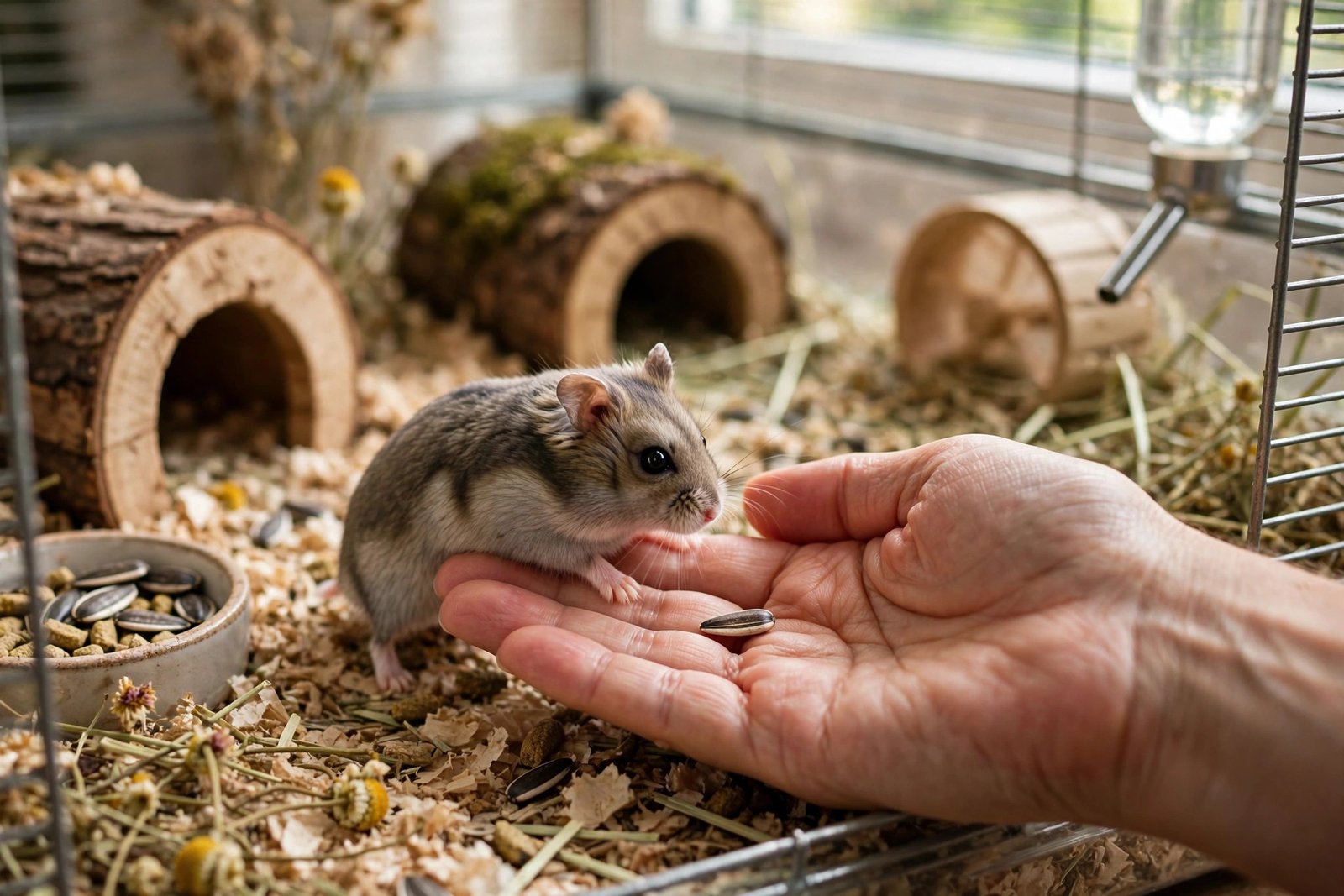
Day 5: The first gentle touch. As your hamster takes a treat, stroke its back once with a single finger, from shoulders to hips, for one or two seconds. Avoid the head — prey animals hate being touched on top of the head. If it flinches, go back to Day 4 for another day.
Day 6: The scoop. Curve both hands slowly around your hamster’s body, forming a bowl, but do not lift yet. Hold for five to ten seconds, then release. This teaches your pet that enclosed hands are safe, not a trap.
Day 7: The first lift. Scoop your hamster and lift it a few centimetres off the cage floor for five to ten seconds, then lower it gently and offer a treat. If it struggles, lower it at once — forcing a lift loses a week’s progress fast. End the week with a short bathtub or playpen session, sitting quietly while your hamster explores around you.
How to Hold a Hamster — and Pick One Up Without a Bite
Once your hamster accepts being lifted, how you hold it matters as much as the taming itself. The scoop method is the safest: both hands cupped on either side of the body, fingers curving underneath, the hamster sitting in the bowl of your palms. Keep it close to your body or a soft surface, in case it jumps. Never grab a hamster from above — that mimics a predator attack and can undo days of trust in a second. Never pick one up by the tail or the scruff, and never squeeze.
The key to how to pick up a hamster without a bite is to approach from the side, at the hamster’s level, and let it see and smell your hand first. If it is hiding in a tube or tunnel, lift the whole tube out and let it walk into your hands from there — the tunnel trick works brilliantly for nervous dwarfs. A hamster that is cornered, woken up or startled is far more likely to bite, so never scoop a sleeping hamster out of its nest. Hold a newly tamed hamster for five to ten minutes; a well-tamed one often enjoys fifteen to twenty.
Why Does My Hamster Bite Me?
A biting hamster is almost always a frightened hamster. Fear or surprise is the most common reason: a hand appearing suddenly, a loud noise, or being grabbed from above triggers a defensive bite — so slow down and go back a step. Hands that smell like food are another classic cause — wash your hands before every session. Being woken up matters too: only train when your hamster is already awake and active. Pain or illness can also turn a tame hamster into a biter — check for wet tail, lumps or a change in eating, and see a vet if anything seems off. Some hamsters guard their cage fiercely but are friendly outside it — if yours lunges in the cage yet relaxes in the playpen, handle it out of the cage.
Learn the difference between a bite and a nibble: a nibble is a gentle, curious mouthing to test whether your finger is food. Stay still, and it stops. A real bite is fast and sharp. If it happens, do not yell or drop your hamster — set it down gently, wash the wound with soap and water, and take a break. Biting the cage bars is different: it usually signals boredom or stress, and a bigger cage with more enrichment often fixes it.
How to Train a Hamster After the First Week
Once your hamster trusts your hands, build on it: use the same word or soft sound every time you offer a treat, and it will soon come running when it hears you. Let it walk from hand to hand, like a slow treadmill, to build confidence outside the cage.
Learning how to play with a hamster is part of bonding too: offer cardboard tubes to explore, scatter food in the bedding so it can forage, and set up a small playpen with hides and a wheel. The secret of how to make a hamster like you is simple: be predictable. Same time, same voice, same gentle routine, every evening — that is the heart of how to bond with a hamster for life.
Syrian vs Dwarf: How Long Taming Really Takes
Species matters. A Syrian (golden) hamster is usually the easiest to tame — bigger, calmer and slower to panic — while dwarf species are quicker, jumpier and need more patience.
| Species | Typical taming time | Notes |
|---|---|---|
| Syrian (golden) | 7–14 days | Calmest, easiest; must live alone |
| Campbell’s dwarf | 2–3 weeks | Curious but nippy at first |
| Winter White dwarf | 2–3 weeks | Gentle once settled; very fast |
| Roborovski dwarf | 3–4 weeks | Tiny, speedy, hardest to handle |
| Chinese hamster | 2–4 weeks | Shy and clingy once bonded |
A young hamster of six to eight weeks usually tames fastest; an older or rescue hamster may need a month or more — but it can still learn to trust you.
Do Hamsters Like to Be Held?
Honestly? It depends on the hamster. Some Syrians genuinely enjoy curling up in a warm hand and will fall asleep there. Most hamsters tolerate handling happily once they trust you. A few — usually Roborovskis — prefer to interact on their own terms and never love being held, and that is fine too.
A hamster that enjoys it shows relaxed ears, slow movement, and climbs onto you voluntarily. One that does not shows flattened ears, freezing, frantic struggling, teeth chattering, or biting. Respect what your hamster tells you.
When Taming Stalls: Quick Fixes
| Problem | Likely cause | Fix |
|---|---|---|
| Runs away every time | Still fearful; sessions too long | Go back a step; keep sessions to 5 minutes |
| Freezes when touched | Fear response (playing dead) | Stop touching; offer treats with a still hand |
| Will not take treats | Too scared, or treat is wrong | Try a smellier treat; train before mealtime |
| Bites when handled | Startled, food smell, or pain | Wash hands; move slower; check for illness |
| Progress lost after a break | Trust fades without practice | Restart from Day 3; handle daily again |
Frequently Asked Questions
How long does taming take?
Most Syrian hamsters take one to two weeks of daily sessions. Dwarf species often need two to four weeks. Older or rescue hamsters may need a month. The timeline matters less than the consistency.
Can you tame an older hamster?
Yes — the same gentle steps work, just more slowly. Go at their pace, use the best treats, and accept progress measured in weeks rather than days.
Should I wear gloves while taming my hamster?
Gloves help if you are nervous about bites, because a confident hand is calmer. But gloves hide your scent, so use them only for the first few sessions and switch to bare hands as soon as you can.
Can children tame a hamster?
Yes, with an adult present. Children should sit on the floor, hold the hamster over a lap or towel, and keep sessions to five minutes. Never leave a child alone with a hamster.
What if my hamster never becomes tame?
Some hamsters stay shy, especially Roborovskis. That does not mean you failed. A hamster that takes treats from your hand and explores near you is already a success — enjoy the bond you have, on its terms.
Final Thoughts
Taming your hamster is not a trick you teach; it is a friendship you build. Start with patience, let your hamster set the pace, and celebrate the small wins: the first sniff of your hand, the first treat from your palm, the first time it climbs in on its own. Keep sessions short and daily, and within a few weeks the shy little animal that once bolted from your hand will be waiting at the cage door for you.
