
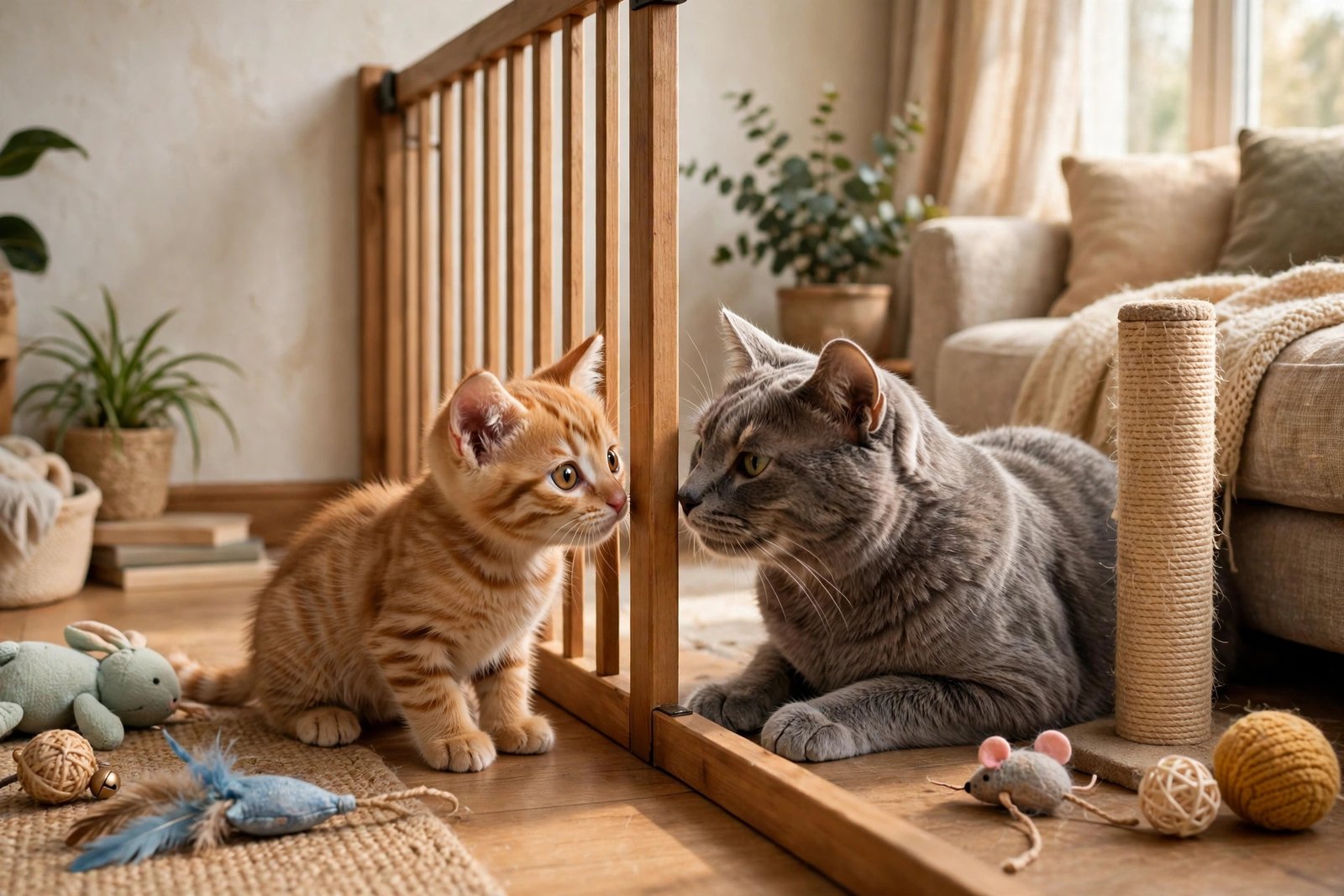
Bringing a new kitten home is exciting — and for the cat who already lives there, it can feel like a small invasion. Cats are territorial by nature, and a sudden face-to-face meeting is the fastest way to start a relationship off badly. The good news is that learning how to introduce a new kitten to a cat is mostly about patience: go slowly, let scent do the talking first, and only move to the next step when both cats are calm. Most pairs settle into a comfortable routine within two to four weeks — and the slow start is what makes that possible.
Before Day One: Vet Check and Base Camp
Before you think about introductions, book a vet visit for the new kitten — the step almost every online guide skips. A kitten from a shelter, breeder, or the street can carry parasites, ringworm, ear mites, or respiratory infections without looking sick, and your resident cat can catch all of these. Ask the vet for a general health check, deworming, flea treatment, and screening for FIV and FeLV if the kitten’s background is unknown. Keep the kitten in its own room — a short quarantine of a few days — until the vet gives the all-clear,
Next, set up the kitten’s base camp: a small, quiet room that belongs to the kitten alone, with its bed, food and water bowls, litter tray, toys, and a hiding spot such as a cardboard box with a hole cut in the side. The base camp gives the kitten a safe place to decompress and keeps the resident cat’s territory intact. When introducing a new cat to your home, gather extra supplies too: a second litter box, a second bowl set, a scratching post, and a cat tree or high perch. One set per cat, plus one extra litter box — two cats need three, in different rooms, so neither can guard the only one.

Step 1: Trade Scents Before They Ever Meet (Days 1–3)
When introducing a kitten to a resident cat, remember cats live in a world of smell. Long before your two cats should see each other, they should know each other’s scent — and learn that it predicts good things. Take a soft cloth, rub it gently around the kitten’s cheeks where its scent glands are, then place the cloth near the resident cat’s food bowl. Do the same in reverse, and swap their bedding and a favourite toy as well. Site swapping helps too: let the kitten explore the house while the resident cat is shut elsewhere, and vice versa. Sniffing and then walking away is perfect. Hissing at a cloth is normal at first and usually fades within a day or two. If either cat refuses to eat near the scented cloth, move it further from the bowl and try again tomorrow. This is also the moment to start a pheromone diffuser, such as Feliway MultiCat, in the room where the cats will eventually meet — one diffuser per roughly 600 square feet.
Step 2: Feed on Opposite Sides of the Door (Days 3–5)
Once both cats are relaxed around each other’s scent, it is time for the first indirect contact: feeding on opposite sides of a closed door. This door-feeding ritual works because it pairs the other cat’s smell and sounds with something every cat loves — dinner. Place each cat’s bowl a few feet from the door, on its own side, and over two or three days move the bowls gradually closer. Both cats should eat calmly before you move the bowls any closer. If either cat stops eating, paces, or growls at the door, move the bowl back to the last distance where it ate comfortably and stay there for another day. The lesson: the other cat’s presence predicts food, not danger.
Step 3: Let Them See Each Other — Safely (Days 5–8)
Now add sight to the mix, but keep a barrier between them. A baby gate, a screen door, or two stacked baby gates (for athletic jumpers) works well. Open the door with the gate in place, and feed both cats a few feet apart, or play with each of them using a wand toy on their own side. Keep these first visual sessions short — five to ten minutes — and end them while things are still calm. A good sign is a cat that glances at the other, then goes back to its food or toy. Mild hissing or a puffed tail in the first session is normal; sustained staring, growling, flattened ears, or lunging at the gate is not, and means you should go back to door feeding for a few more days. Keep a blanket nearby as a sight blocker so you can calmly block the view if things get tense.
Step 4: Supervised Meetings in a Big Room (Days 8–14)
When both cats eat and play calmly on either side of the gate, they are ready for a real meeting. Choose a large room with escape routes and high places, so neither cat feels cornered. Have a partner if possible — one person per cat. Keep the first meeting to just a few minutes, then separate them again on a high note and lengthen the meetings a little each day. Some hissing and swatting is normal — cats set boundaries with a hiss the way people do with a firm “not yet.” What you do not want is a full chase, a cat that will not stop pursuing, or a fight where one cat cannot get away. If that happens, do not reach in with your hands — toss a cushion or blanket between them, separate them calmly, and go back to the gate stage for several days.
Reading Cat Body Language: Ready or Not Yet?
Knowing how to introduce cats to each other is mostly about reading the room. A relaxed cat that is ready to move forward has ears forward, whiskers relaxed, a tail held up or gently curved like a question mark, and a soft blink; it eats and grooms normally and sleeps in open spots. Learning these signals makes every step easier — our guide to why cats purr explains one of the most misunderstood signals of all.
A stressed cat that needs more time shows flattened ears, wide round pupils, fur standing on end, a tail tucked tight or lashing quickly, and a low crouch with weight shifted back. It may growl, refuse food, hide for hours after a session, or stop using the litter box. Lasting changes in eating, hiding, or toileting may be more than stress — see our guide to the common signs of cat illness.
If unsure, stay at the current step for two more days.
How Long Does It Take for a Cat to Accept a New Kitten?
This is the question every new cat owner asks. The honest answer: it depends on the cats, but most pairs need two to four weeks before they are comfortable sharing space unsupervised. Kittens adapt faster than adults, and two young cats often become friends within days. An older cat meeting a new kitten may need the full month — or a little longer — and that is completely normal. A useful framework is the 3-3-3 rule for new cats: three days to decompress, three weeks to learn the routine, and three months to truly feel at home. Leave the cats unsupervised together only after several calm meetings of at least an hour each, with no chasing, no sustained hissing, and both cats eating, playing, and sleeping normally. The first weeks are also not the time to leave a kitten alone for long — see our guide on how long you can leave a cat alone.
Introducing a New Kitten to an Older Cat: Special Care
Learning how to introduce a kitten to an older cat takes extra patience, because the two animals want very different things. A kitten is a bundle of energy that wants to play, pounce, and wrestle all day; a senior cat wants quiet, warmth, and routine — and may have arthritis, poor eyesight, or a health condition that makes rough play painful. If your older cat is frail, anxious, or has never lived with another cat, a boisterous kitten may be a poor match. If you do go ahead, protect the older cat’s space — its favourite sleeping spot, food bowl, and litter box in places the kitten cannot ambush — and give it high perches and hiding spots where a kitten cannot follow. Play with the kitten separately every day to burn off its energy before any shared session, keep shared sessions short, and always end them before the kitten’s excitement turns into pouncing. Many senior cats end up tolerating — and some genuinely enjoying — a kitten’s company, especially once the kitten calms down at around six months old.
Troubleshooting: When the Introduction Stalls
If the hissing never stops, go back to the last step where both cats were calm and stay there for at least three days, then move forward more slowly — smaller steps, shorter sessions, higher-value treats. If one cat guards the food or litter box, add more resources and spread them out: one litter box per cat, plus one extra, with bowls and boxes in different rooms so no single cat can control them all. If there is a real fight, separate the cats for at least 24 hours, then restart from the scent-swapping stage — and never punish either cat, because punishment after a fight only adds fear to the relationship. If fights keep happening despite a slow re-introduction, talk to your vet or a board-certified veterinary behaviourist. If the kitten is too rough, increase solo play, offer puzzle feeders, and end shared sessions the moment play gets too intense.
Learning how to introduce a kitten to a cat is not a race: the slow route — scent first, then sound, then sight, then shared space — is the route that works, and the two to four weeks it takes are a small price for years of peace between your cats. Once they share the house peacefully, keep the good habits going: separate feeding, the extra litter box, and individual play. The cats that look like best friends after two weeks are lovely, but the ones that simply ignore each other politely are also a success.
Frequently Asked Questions
How long will it take for a cat to accept a new kitten?
Most pairs need two to four weeks. Use the 3-3-3 rule: three days to decompress, three weeks to learn the routine, three months to feel at home.
What is the 3-3-3 rule for new cats?
Three days to decompress, three weeks to learn the routine, three months to feel at home — for the kitten and for the friendship.
How do I get my older cat to accept a kitten?
With a new kitten and older cat, go extra slowly, protect the older cat’s spots and resources, tire the kitten out with solo play first, and keep meetings short. If the older cat is frail, a calmer adult cat may be a better match.
Should I let the kitten and cat meet on the first day?
No. Knowing how to introduce a new kitten to your cat starts with separation: keep them apart for the first few days, swap scents, then feed on opposite sides of a door before any visual contact.
Is hissing normal when introducing cats?
Yes — hissing is how cats set boundaries. A sustained chase, a fight with no escape, or a cat that stops eating or hides for hours means slow down and go back a step.
How many litter boxes do I need for two cats?
Three — one per cat, plus one extra — in different rooms. Same for food and water bowls.
