
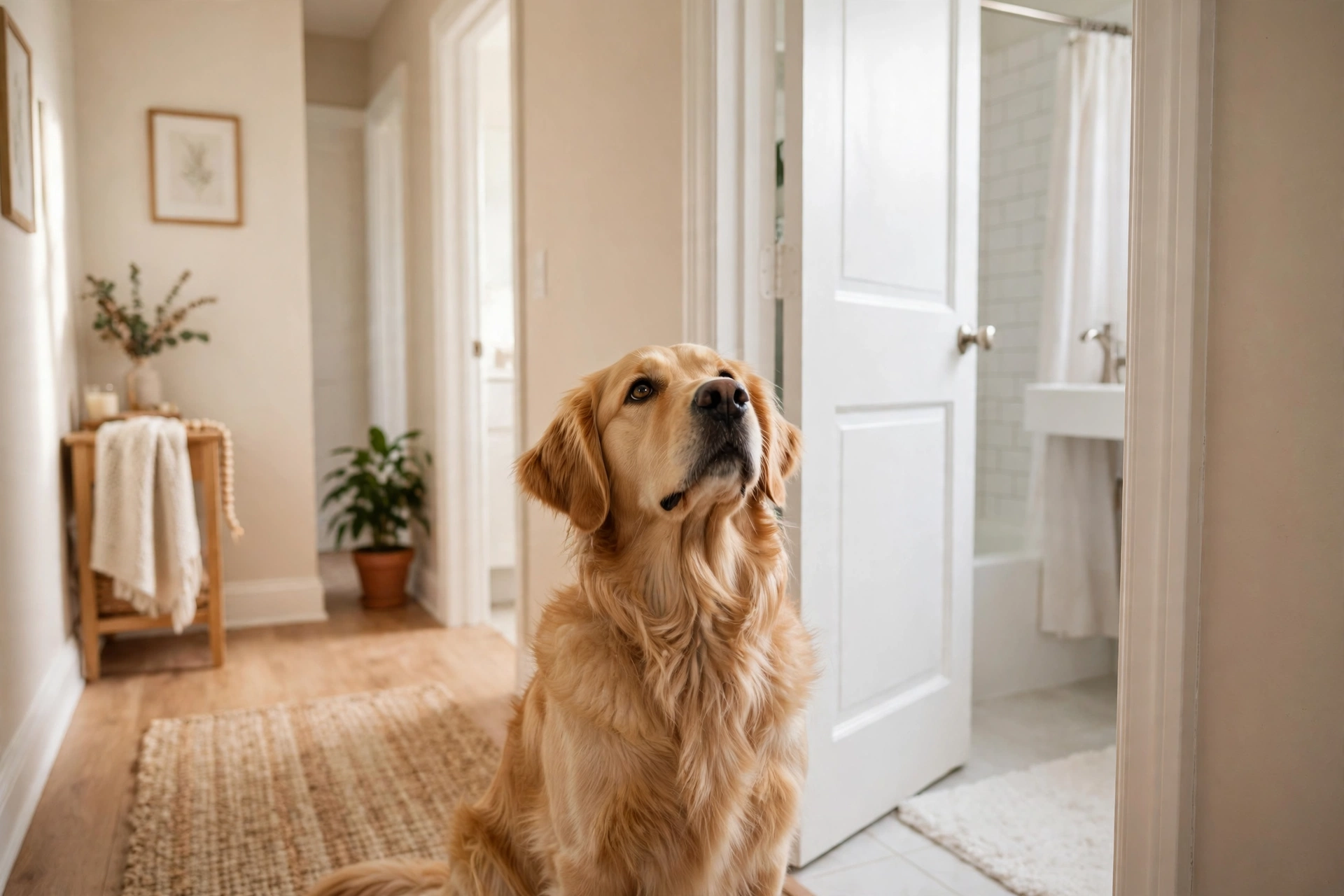
You close the bathroom door. Two seconds later, a nose slides under it, paws scratch at the wood, and a very patient dog settles down on the other side to wait. If this is your daily life, you have a shadow dog. Dogs that trail their owners from room to room are one of the most common things owners ask trainers about — my dog follows me everywhere, and the bathroom version is the one that makes people laugh and wonder in equal measure. So why does my dog follow me to the bathroom — and why does my dog follow me everywhere I go?
The short answer is that following you is normal dog behaviour. Dogs are social animals bred for thousands of years to live close to people, watch us, and work beside us. Most of the time, a dog that shadows you is showing attachment, curiosity, or a learned habit — not a problem. But there is a line between a loving shadow and a dog that cannot cope alone. Below are eight reasons, a shadow decoder to read your own dog, why the bathroom is the favourite destination of all, and a gentle seven-day plan for teaching a clingy dog to settle on its own.
Why Does My Dog Follow Me to the Bathroom? The Short Answer
Usually for the same reasons your dog follows you anywhere else: you are the most interesting, most rewarding, and most reassuring thing in the house. The bathroom is simply where the habit is most obvious, because it is the one room where you close the door. If your dog trails you to the kitchen, the sofa, and the garden gate too, the bathroom is not a special obsession — it is just the most visible stop on a route your dog walks all day long.
8 Reasons Your Dog Follows You Everywhere
1. Love and attachment
The simplest reason is the best one. Dogs form deep attachments to the people they live with, much like a young child attaches to a parent. Brain studies show the parts of a dog’s brain linked to emotion light up when they see or smell their owner. A dog that follows you is choosing your company over an empty room. That is a compliment, even when it is inconvenient. Many shadow dogs also insist on sleeping at your feet at night, keeping the same close watch while you rest.
2. You are the source of all good things
Dogs keep careful track of who opens the food cupboard, who clips on the lead, and who produces treats from a pocket. If being near you has ever led to a meal, a walk, a game, or a cuddle, your dog has learned that sticking close pays off.
3. Breed: some dogs are born shadows
Genetics plays a real part. Herding breeds such as Border Collies and Australian Shepherds were bred to watch people closely, so they tend to shadow their owners. Toy breeds such as Cavalier King Charles Spaniels were bred purely as companions and often want to be touching you, and Labradors, German Shepherds, and Vizslas also score high for owner-seeking behaviour.
4. Puppy imprinting and early life
Dogs that came home very young or spent their first weeks with one person often bond intensely to that person. Puppies also follow because they are still learning how the world works and their owner is their safe base.
5. Boredom and an empty schedule
A dog with nothing to do will find something to do, and the easiest entertainment in the house is you. Under-exercised dogs often follow their owners around the house simply because there is nothing better on offer — one honest answer to why does my dog follow me everywhere is that I am the most interesting thing in the room. If the shadowing gets worse on rainy days or days without a walk, boredom is a likely driver, and it is one of the easiest reasons to fix.
6. Communication: your dog is telling you something
Sometimes following is a message. A dog that trails you, whines, and glances at the back door may need the toilet; one that follows you into the kitchen at the same time every evening is probably reminding you that dinner is late. Dogs also follow when they want play or a belly rub, and when something feels wrong — a strange noise, an unfamiliar visitor, or a sore paw.
7. Anxiety and the need for reassurance
For some dogs, following is comfort-seeking. A nervous dog feels safer near its owner, especially during thunderstorms, fireworks, or house moves. The more serious version is separation anxiety, where a dog panics when left alone — barking, drooling, pacing, chewing door frames, or having accidents indoors. If your dog cannot settle even in the next room, that is anxiety, not just affection.
8. Watching over you — including when you are unwell
Dogs are remarkably tuned to their owners. Many owners report that their dog follows them more closely when they are ill, upset, or recovering from an injury, and some dogs are trained to do exactly this as assistance dogs.
The Shadow Decoder: What Your Dog’s Following Style Means
Not all following is the same. Read the pattern, not just the fact that your dog is behind you. Here is a quick decoder.
| Following style | Body language | Likely meaning | What to do |
|---|---|---|---|
| Relaxed shadow | Loose body, soft eyes, lies down nearby | Affection and habit | Enjoy it; teach a “settle” cue for busy moments |
| Excited shadow | Bouncy, tail wagging, brings a toy | Boredom or play-seeking | Add a walk, a puzzle feeder, or a training game |
| Anxious shadow | Panting, pacing, whining, cannot settle | Anxiety or separation distress | Build independence slowly; see the plan below |
| Needy shadow | Nudging, pawing, staring at you and vocalising | Learned attention-seeking | Reward calm settling, not the nudging |
| Sudden shadow | A new habit in an older dog, plus clumsiness or confusion | Possible pain, hearing or sight loss | Book a vet check promptly |
Why the Bathroom, of All Places?
The bathroom wins the prize for a few very dog-like reasons. First, the door closes, and closed doors are irresistible to a curious animal. Second, your scent is strongest there, and scent is how your dog reads the world. Third, the bathroom is small and warm — a cosy den-like space where your dog gets to be close to you. Fourth, routine: if you have ever let it in while you got ready, it has learned that the bathroom trip is a social event. Your dog is not obsessed with the bathroom itself — it is obsessed with you.
Is It Normal? When Following Becomes a Problem
For most dogs, following is normal and harmless. It becomes a problem when it interferes with your life or your dog’s welfare. Watch for these red flags: your dog panics when you leave the room, even briefly; it cannot eat, sleep, or play unless you are in sight; it injures itself trying to reach you; it growls at family members who come near you. A sudden change matters most of all. If a previously independent dog suddenly starts shadowing you, that can be a sign of pain, failing eyesight or hearing, canine cognitive dysfunction in a senior dog, or a big change at home such as a move or a new baby. A new behaviour in an older dog always deserves a vet visit.
The 7-Day Independence Plan
Do not shut your dog out or punish the following — that makes anxiety worse. Instead, teach your dog that being alone is safe and rewarding, in small steps:
Day 1–2: Reward settling. Put a bed or mat a few steps away from you. Every time your dog chooses to lie on it, quietly drop a treat between its paws.
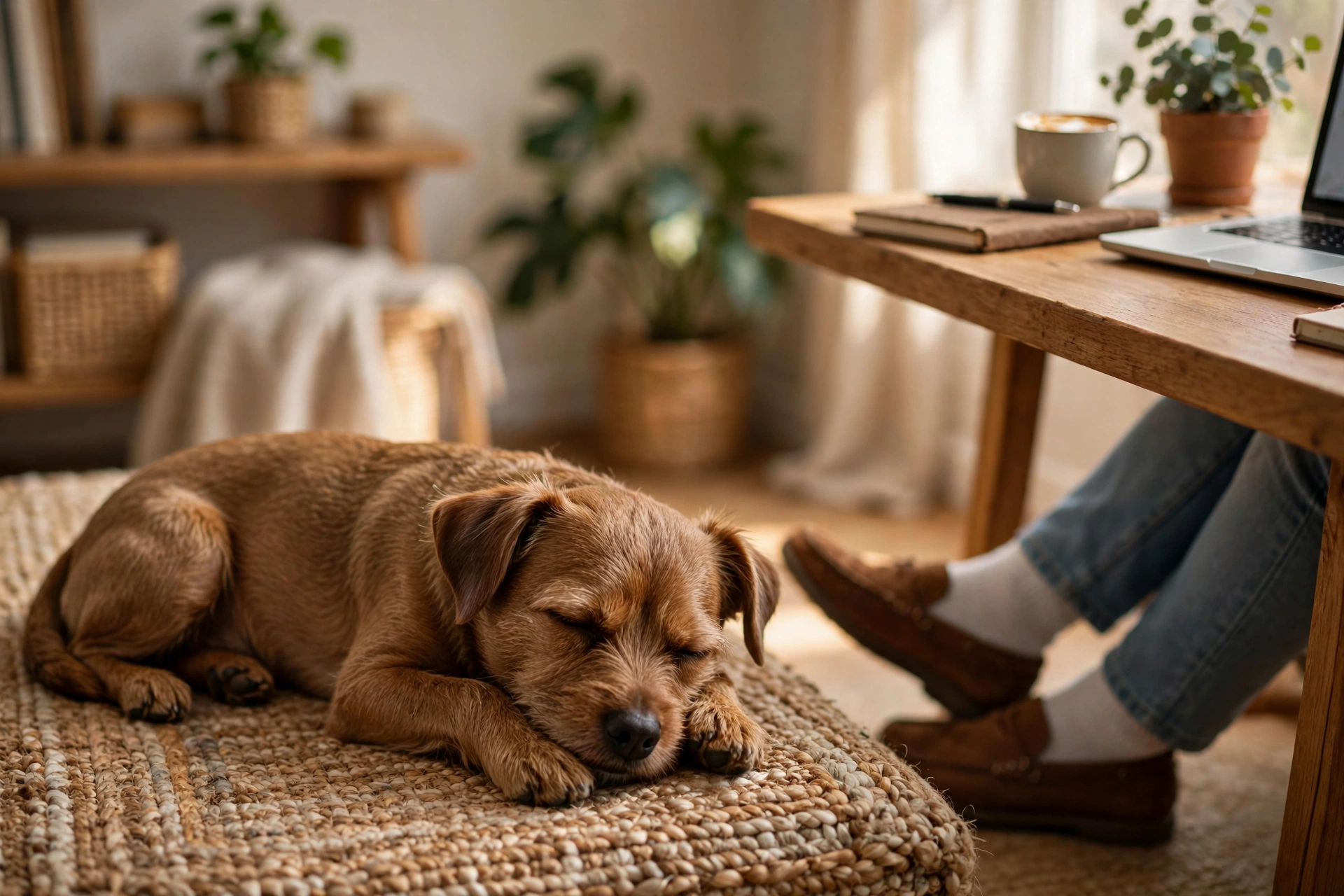
Day 3: Add distance. Move the mat to the doorway, then just outside the room. Practise short “stay” and “place” cues for five minutes.
Day 4: Close the door for seconds. Step into the bathroom, close the door, count to ten, and come back out calmly before your dog gets upset. Repeat a few times.
Day 5: Build the gap. Stretch the closed-door time to one minute, then five, giving your dog a stuffed food toy or lick mat while you are gone.
Day 6: Leave the house briefly. Pop out for five minutes, then ten, leaving the radio on and a puzzle feeder behind. Return calmly. If your dog panics at any step, go back to the previous step for a day.
Day 7: Make it a habit. Build two short alone-time sessions into every day, keep departures and arrivals low-key, and make sure your dog gets a proper walk and some play first. A tired dog settles far more easily than a bored one.
If your dog shows real distress — drooling, howling, destructive chewing, or escape attempts — stop pushing the duration and talk to your vet or a certified behaviourist. Medication and a structured desensitisation plan help many dogs.
What NOT to Do
Do not scold or push your dog away for following you; fear makes clingy behaviour worse, not better. Do not sneak out of the house — dogs learn departure cues quickly, and sneaking teaches them to watch you even harder. Do not give in to every nudge and whine with attention or food, because that rewards the very behaviour you want to reduce. And do not expect an overnight fix: a habit built over months takes weeks to reshape.
When to Call the Vet
Call your vet if the following started suddenly, if your dog is older and also seems confused, bumping into things, or sleeping far more than usual, or if the following comes with appetite loss, limping, vomiting, or any sign of pain. Also seek help if your dog injures itself when left alone, or if the 7-day plan makes the distress worse. A vet can rule out pain, thyroid problems, and cognitive decline, and can refer you to a behaviourist for separation anxiety. These are the same warning signs that matter when a dog starts staring at you, so take a sudden change in either behaviour seriously.
FAQ
Why does my dog follow me everywhere and stare at me?
Because you are the centre of its world: staring is how dogs read your face for cues, and following keeps them close to food, walks, and affection. If the staring is new or intense, or paired with confusion or circling, see a vet.
Why is my dog so clingy all of a sudden?
A sudden change often follows a change at home — a move, a new person or pet, new working hours — or a health problem such as pain or failing senses. If nothing has changed at home, a vet check is the right first step.
Is it bad if my dog follows me everywhere?
Usually not. It is normal social behaviour. It is only a problem when your dog cannot cope alone, panics on separation, or the behaviour makes daily life difficult or unsafe.
Why does my dog follow me around the house but not my partner?
Dogs usually attach most strongly to the person who feeds them, walks them, and spends the most time with them — or simply see you as their favourite person. It is rarely a slight against the other person.
How do I stop my dog from following me into the bathroom?
Teach a “place” cue on a mat outside the bathroom, reward your dog for staying there, and practise very short closed-door separations, building up gradually. A food puzzle or lick mat helps. Never punish the following — reward the settling.
A dog that follows you to the bathroom is, most of the time, a dog that loves you and has learned that good things happen near you. Enjoy the compliment, read the pattern with the decoder, and if the shadowing is tipping into anxiety, use the seven-day plan to build your dog’s confidence one step at a time.
