
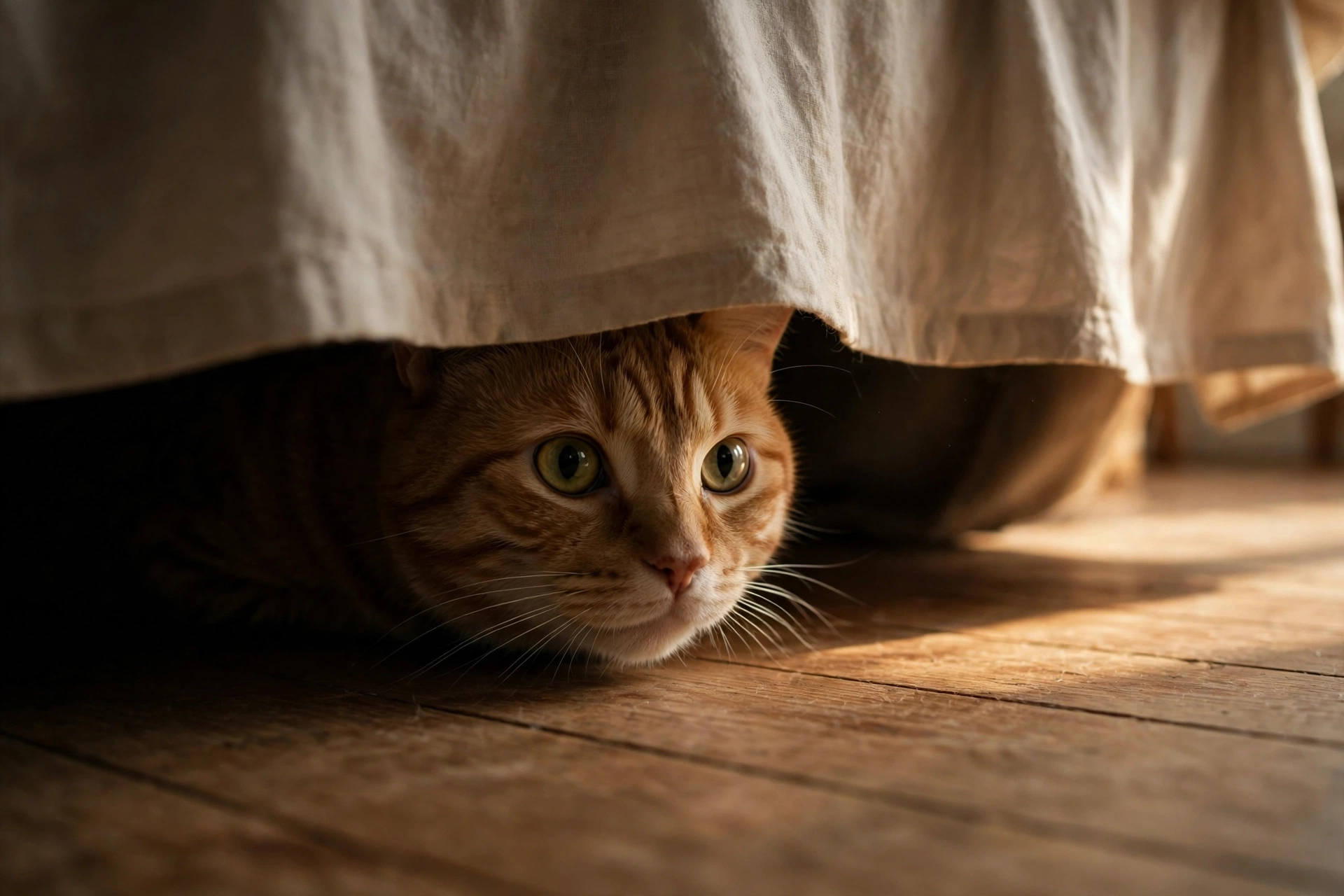
Your cat was on your lap yesterday. Today the house is quiet, the food bowl is untouched, and the only sign of your cat is two eyes blinking from under the bed. If you are asking why is my cat hiding all of a sudden, you are asking the right question — because a sudden change in cat hiding behavior is worth understanding, not ignoring.
Hiding itself is normal — what matters is “suddenly”. Below are the 12 reasons, a decoder, what the hiding spot reveals, and a 24-hour check.
Why Do Cats Hide? The Instinct Behind It
To understand why do cats hide, remember your house cat is both predator and prey. In the wild, a small feline survives by staying unseen: it hides to stalk prey, and it hides to avoid becoming prey. Domestic cats share 95.6% of their DNA with the tiger, and that survival wiring is still switched on in your living room.
So when something feels wrong, the ancient answer is the same: find a small, dark space and wait. A box, a closet, or the shadow under the bed all feel like a safe den. Hiding is a coping strategy, not spite — your job is to find what your cat is coping with.
The 12 Reasons Your Cat Is Suddenly Hiding
Why is my cat suddenly hiding? Most cases come down to one of these twelve causes — read them with your last 48 hours in mind.
1. Visitors or strangers in the house
Cats are creatures of routine, and new people break it. A guest, a workman, or a loud group of friends can send a shy cat under the bed.
2. Loud or strange sounds
Fireworks, thunderstorms, a vacuum cleaner, or construction next door can frighten a cat into hiding — cats hear far better than we do.
3. Illness
This is the reason to take most seriously. Cats mask sickness well, and retreating to a quiet corner is often one of the first signs something is wrong. Wondering why do cats hide when they are sick? A sick animal feels vulnerable, so it hides while it rests — watch for appetite changes, lethargy, or altered litter-box habits too.
4. Pain
A cat in pain hides for the same reason a sick cat does: vulnerability. A stepped-on paw, a sore tooth, arthritis, or an unseen injury can drive a cat into seclusion. If your cat flinches or cries out when touched, suspect pain.
5. A new home or rearranged rooms
Moving house is one of the most stressful events in a cat’s life. Even smaller changes count: new furniture, a redecorated room, a moved litter box. Give a cat in a new home a small safe room with food, water, and a litter box, and let it explore at its own pace.
6. A new addition to the household
A new baby, partner, pet, or frequent houseguest changes the family scent and the daily routine. Your cat may hide until it decides the newcomer is safe.
7. Stress or anxiety
Sometimes there is no single event, just a build-up: a changed work schedule, tension between pets, a neighbour’s cat at the window. Chronic stress shows up as hiding, overgrooming, or a cat that startles easily.
8. Fear of a specific person or pet
If your cat always vanishes when one person arrives, or when the dog comes indoors, that is a clue — rough handling, loud children, or a chasing dog can teach a cat that hiding is safest.
9. Pregnancy and nesting
An expectant queen often starts hiding as her due date approaches, seeking a safe, warm, enclosed spot to give birth and nurse her kittens. Provide a warm box in a quiet corner and leave her to it.
10. Overstimulation or too much attention
Cats prefer short bursts of play and affection to long sessions. A cat that has been picked up and cuddled for too long may simply need downtime — and hiding is how it takes it.
11. Poor early socialisation or a shy nature
Kittens not handled much before nine weeks of age often grow into adults that hide more. Breed plays a part too: University of Helsinki research found Russian Blues among the most fearful breeds, while Persians scored lowest on sociability toward humans.
12. A fright after a vet visit, carrier trip, or boarding stay
The carrier, the car, the vet’s table, a cattery — any of these can leave a cat shaken for a day or two. Hiding after a stressful outing is normal and usually fades within 24 to 48 hours.
The Hiding Decoder: Normal Retreat or Red Flag?
Not all hiding is equal — use this decoder before you panic, or relax.
| What you see | Normal retreat | Time to worry |
|---|---|---|
| Hiding place | Familiar safe spot | A new or unsafe spot |
| Appetite | Comes out for meals | Skipping meals or water |
| Posture | Relaxed, slow blinks | Hunched, tense, frozen |
| Response to you | Emerges for a treat | Refuses to emerge, hisses |
| Duration | Hours, then back to normal | Over 24 hours |
One right-hand row is a watch-and-wait; two or more is a vet call. Learning basic cat body language helps you tell a relaxed cat from a frightened one.
Where Is Your Cat Hiding? What the Spot Tells You
Under the bed. The classic choice: dark, enclosed on three sides, and smelling like you. If you are asking why is my cat hiding under the bed, the usual answer is fear or a need for quiet after a stressful event.
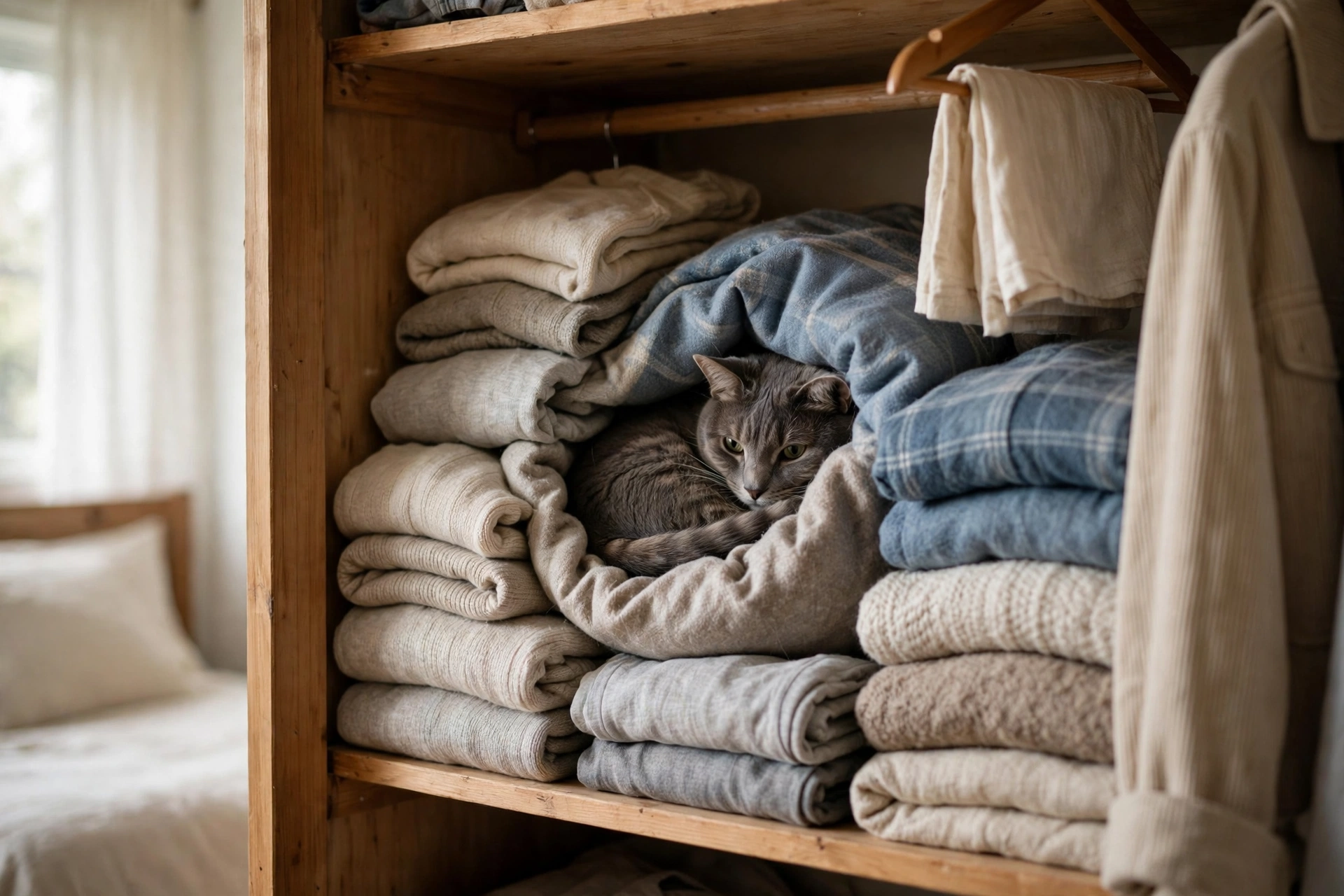
In a closet or cupboard. A closet full of soft clothes is warm, dark, and muffled — a perfect den. Cats hiding here often seek comfort as much as safety.
Up high — a bookshelf, wardrobe top, or cat tree. A cat that hides up high is watching, not just cowering. High places let a cat survey the room while staying out of reach.
Behind furniture or appliances. Behind the sofa or fridge usually means genuine fear — the cat wants a barrier between itself and the room. Do not pull it out; wait for it to choose to emerge.
The 24-Hour Check: A Step-by-Step Detective Routine
Run this check over one day instead of guessing.
- Note when it started. When did you last see your cat behaving normally? What happened in the hour before — visitors, noise, a new object, a vet trip?
- Check the basics. Is food eaten, water drunk, and the litter box used? Write it down; memory blurs under worry.
- Look at the body. Check for limping, flinching when touched, drooling, eye or nose discharge, and any change in grooming.
- Scan the house for changes. New furniture, a moved bed, a new candle, a neighbour’s cat at the window — any change counts.
- Offer a calm invitation. Sit near the hiding spot, speak softly, and offer a favourite treat. Note whether your cat responds at all.
- Give it until tomorrow. If eating, drinking, and toileting are normal and the hiding is easing, keep the house calm. If nothing has improved in 24 hours, call your vet.
How to Coax Your Cat Out of Hiding
Patience beats force every time. Sit nearby and read so your cat gets used to your presence without pressure. Speak in a low, steady voice. Place food and water close to — never inside — the hiding spot, so your cat need not cross open ground to eat. Offer a familiar toy or treat, then leave it and walk away; many cats only emerge when nobody is watching. Watch for small good signs: slow blinks, a relaxed tail, or kneading on a blanket all mean your cat is starting to feel secure again.
What NOT to Do When Your Cat Hides
Never drag a cat out of its hiding place, block the exit, or corner it — a frightened cat that feels trapped may bite, and it will trust you less next time. Do not stare into its eyes, loom over it, or make sudden movements. Do not punish hiding, and do not shut the cat in a room with the thing that scared it.
Hiding and Not Eating: The Pair That Matters Most
Hiding alone is often harmless. Hiding plus a loss of appetite is the combination vets worry about. If you are asking why is my cat hiding and not eating, the honest answer is that the two together point most often at illness or pain, and they need a professional opinion soon. A cat that skips food for over 24 hours — especially an overweight cat — risks a serious liver condition called hepatic lipidosis. Offer warmed wet food, and note exactly when your cat last ate: that is the first thing your vet will ask.
A Newly Adopted Cat Hiding Is Normal — With Limits
A newly adopted cat that hides for the first few days is doing exactly what a sensible cat does in strange new territory. Keep it in one quiet room with food, water, a litter box, and a hiding box of its own. Most new cats start exploring within three to seven days. If one is still hiding constantly after two weeks, or it is not eating, ask your vet or the shelter for advice.
When to Call the Vet: The Checklist
Call your vet if your cat shows any of these alongside the hiding: not eating for over 24 hours, not drinking, vomiting or diarrhoea, difficulty breathing, limping or crying out in pain, or hiding for over 24–48 hours without improvement. Senior cats hide illness especially well, so a sudden change in a cat over ten years old deserves a check even if it looks minor. If unsure, call anyway. For a fuller picture of the warning signs, read our guide to the common signs of cat illness before your appointment.
FAQ
Why is my cat hiding?
Something usually changed — a sound outside, a new smell, a neighbour’s cat at the window, or the first twinge of illness. Run the 24-hour check and watch appetite and litter-box habits.
Why is my cat hiding from me specifically?
It is rarely personal. Your cat may be reacting to the moment — a loud voice, a new perfume, being picked up when it did not want to be — or it may be unwell and avoiding everyone. If it hides only from one person, check that person’s behaviour around the cat first.
Why is my cat hiding under the bed and refusing to come out?
Under the bed is the most popular hiding spot: dark, enclosed, and smelling like you. Leave food and water nearby, keep the house quiet, and let your cat choose when to emerge. If it refuses food and water for a full day, call your vet.
Why do cats hide when they are sick?
A sick cat feels vulnerable, and hiding is an ancient survival instinct — in the wild, a weak animal that stays visible becomes prey. That is why hiding is often the first sign of illness.
How long is too long for a cat to hide?
A few hours after a fright is normal. More than 24 hours, or hiding that is getting worse, is too long. If your cat is also not eating or drinking, call your vet the same day.
Hiding is your cat’s way of saying the world feels unsafe right now. Most of the time the cause is simple — a visitor, a noise, a change of furniture — and a quiet house and a little patience bring your cat back out. But sudden hiding is also one of the earliest signals of illness, and cats are experts at hiding sickness until it is serious. If you are still asking why is my cat hiding all of a sudden after the 24-hour check, trust your instincts and call your vet.
