
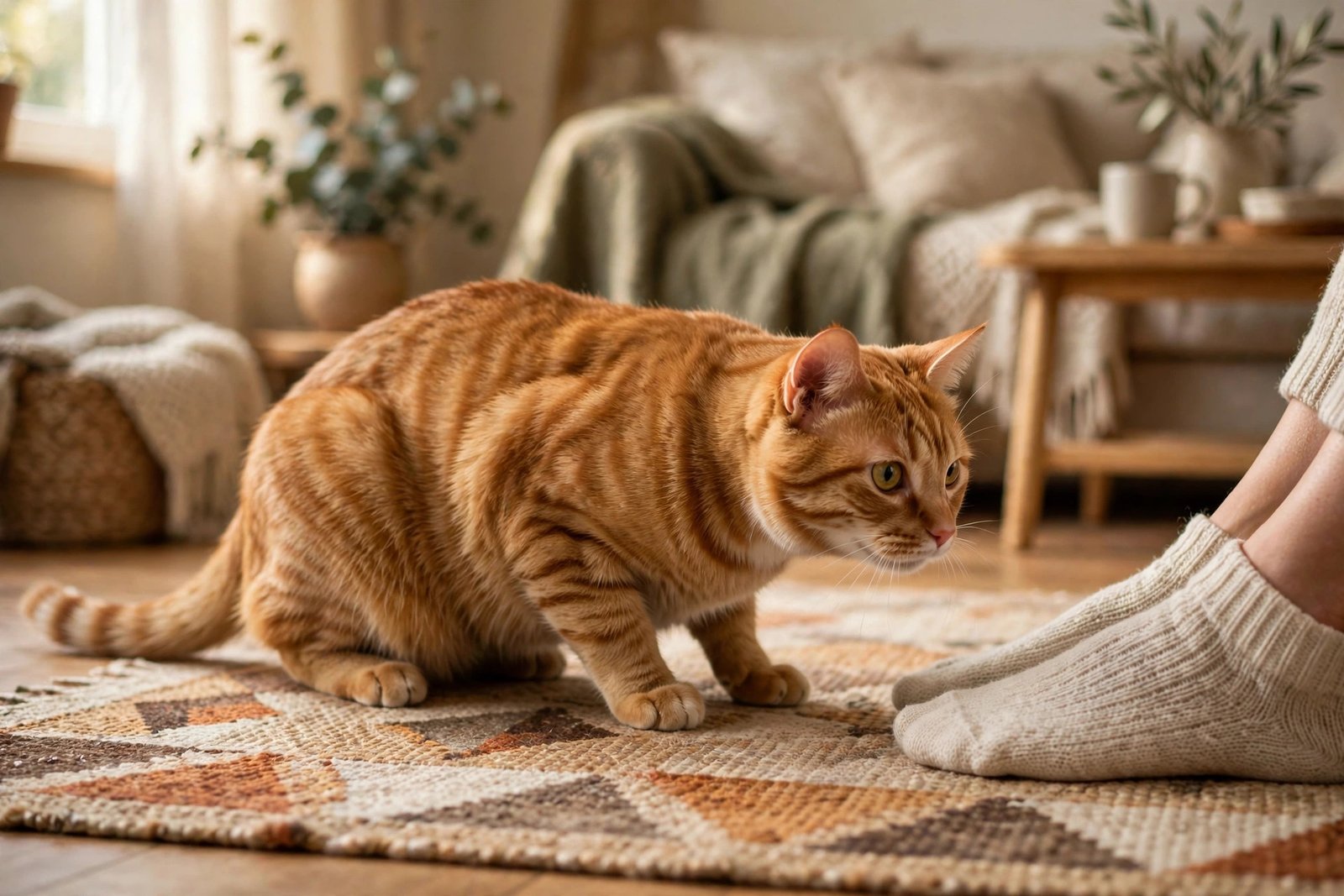
You are half awake, shuffling to the kitchen in socks, when a grey streak shoots out from under the sofa, grabs your ankle, bites, kicks, and vanishes before you have finished yelping. If that is your morning, you have probably asked it more than once: why does my cat bite my feet? Relax. Your cat does not hate you. Foot-biting is one of the most common complaints in cat homes, and it makes sense once you see it from your cat’s side.
Is It Normal for a Cat to Bite Your Feet?
Yes, very normal. Even the laziest lap cat is built to hunt: stalk, crouch, pounce, bite. A cat living outside would spend a good part of its day doing exactly that. Indoors there is nothing to catch, so the urge looks for the next best thing — a swinging shoelace, or a heel passing the sofa. Kittens and young cats do it the most, and many grow out of it by around two. Not every foot attack is a game, though — a hurting, frightened or overstimulated cat can go for feet too.
7 Reasons Your Cat Bites Your Feet
Usually it is one of these, sometimes two at once. It helps to notice when it happens: a 6 a.m. ankle grab and a swat while you are petting the cat have very different causes. Cat biting ankles and feet is almost always the same behaviour wearing a different name.
1. Your Feet Move Like Prey
Cats are tuned to small, jerky movement. A mouse scurries in short bursts and stops; your toes wiggling under a desk do pretty much the same thing. Your cat does not think about it — the movement flips a switch, and the body goes into hunting mode. That is why the attack so often comes from hiding under a bed or behind a chair. This is the most common answer to why do cats bite feet, and why bare feet and socks get attacked far more than shoes.
2. Play Aggression, Especially in Kittens
In a litter, kittens learn to play by wrestling each other. They bite and kick, and a sibling lets out a squeal when a bite goes too far. A kitten that left its litter early, or that is the only pet in the house, misses that feedback, so it wrestles you instead — mostly your feet, since they are at kitten height. This is classic cat play biting: the bites are usually soft, the ears stay forward, and the kitten comes back for more.
3. Boredom and Pent-Up Energy
An indoor cat that sleeps all day while you are at work has a full tank of energy by evening and nowhere to spend it. When you walk in and start moving around, your feet become the entertainment. Knocked-over cups, shredded toilet paper and midnight zoomies are classic signs. It gets worse in single-cat homes, and when owners are away for long stretches — if you are unsure how long you can leave a cat alone, most adult cats cope with a workday but not with days of solitude.
4. They Want Your Attention (or Breakfast)
Cats learn fast: if grabbing your ankle got a reaction yesterday, it will probably happen again today, and even a shout counts as attention. Food fits in here as well. A lot of foot attacks happen first thing in the morning, and that is no accident: cats are crepuscular, most active around dawn and dusk. A hungry cat at sunrise and feet heading toward the kitchen are a tempting combination. The same logic explains why does my cat bite me when I am sitting still — sometimes the bite is just a tap that says “notice me”.
5. Toes Under the Blanket
To a cat, feet moving under the covers look like small prey in grass. You cannot see them, they twitch every now and then, and the blanket makes a little shifting bump. That is almost too perfect a target. It is one of the easiest versions of cat biting feet to fix: just make your toes boring or unreachable at bedtime.
6. Someone Taught Them Feet Are Toys
This one is a bit awkward. A lot of cats learned to attack feet from the people who love them. Wiggling your toes at a tiny kitten is adorable, and letting it chew your socks seems harmless. Then the kitten grows into a ten-pound cat with real teeth, and the game has not changed. Consistency matters more than anything, and it has to apply to everyone in the house. One person playing with feet undoes a lot of work.
7. Overstimulation, Pain or Redirected Aggression
Sometimes the attack is not about play at all. Some cats get overstimulated by petting, and once they hit their limit they bite whatever is closest. A related habit is when your cat licks and then suddenly bites during a cuddle — our guide on why your cat licks then bites explains the warning signs. Redirected aggression is different: your cat spots another cat through the window, or hears something scary, and gets worked up. You walk past, and your ankle takes the hit. If you are wondering why does my cat attack me out of nowhere, this is often why. Pain can do the same thing: sore joints, dental pain and arthritis can all make a cat lash out.
Play Bite or Real Aggression? How to Tell
Playful attacks and angry ones can look alike for a second, but the body language gives it away. Learning to read cat body language is the fastest way to know whether you are dealing with a game or a warning.
| Sign | Play | Real aggression |
|---|---|---|
| Body | Low crouch, wiggling rear | Stiff, tense, side-on |
| Ears | Forward and alert | Flat or turned back |
| Claws | Mostly sheathed | Out, breaking skin |
| Sounds | Quiet, maybe a chirp | Hissing or growling |
| Tail | Twitching with excitement | Lashing and thumping |
| Afterward | Runs off, comes back for more | Keeps its distance |
A gentle nibble is usually a love bite or a play bite. A grab-and-kick is the hunting sequence in miniature — dramatic, but still play if claws stay sheathed. A hard bite that breaks skin, with flattened ears and a hiss, is a warning.
How to Stop a Cat From Biting Your Feet
You cannot switch off the hunting instinct. The goal is to give it somewhere better to go than your ankles — these are the same rules that explain how to stop a cat from biting in general.
Play Every Day, Before the Danger Hours
Two short play sessions a day make the biggest difference: ten to fifteen minutes each, with a wand toy that moves like prey. Let your cat stalk it and actually catch it at the end. Play before the times your cat usually attacks — when you get home, or right before bed, followed by a small meal.

Go Still When It Grabs You
When your cat grabs your foot, stop moving. Pulling away makes you act more like prey, and prey that struggles is more fun. Freeze, wait until it lets go, then calmly walk off or hand it a toy. No yelling — boring is the point.
Give Them a Kicker Toy
A kicker is a long, soft toy a cat can hug with its front paws and bunny-kick with the back ones. It scratches the exact itch your ankle is scratching. Keep one near the ambush spots, and toss it in front of your cat when you see the crouch and the wiggle.
Keep Hands and Feet Out of Games
From now on, every game uses a toy. That goes for everyone in the house. If a kitten is allowed to wrestle your hand today, it will wrestle your ankle tomorrow. Redirect every bite onto a toy, and praise the gentle play that follows.
Fix the Morning Ambush
If the attacks happen around breakfast, try an automatic feeder set for just before you wake up. Your feet stop being linked to food. And never feed straight after a bite — wait until your cat is calm, even if it is only a minute.
Make Bedtime Boring for Toes
For night attacks, tuck your feet under a heavier blanket, wear socks to bed, or keep the cat out of the bedroom for a few weeks. A puzzle feeder outside the door gives it something else to do.
What NOT to Do
Do not push your cat away with your foot, and never hit it — that can turn a game into real fear, and some cats get rougher. Spray bottles are not a great idea either: your cat will not connect the squirt with attacking feet, it is far more likely to connect it with you. Do not chase your cat after a bite, and do not give up after a few days — a habit like this took months to form.
What to Do If a Cat Bite Breaks the Skin
Most foot bites are harmless, but a puncture deserves attention: cat teeth are thin and sharp and push bacteria deep into tissue. Wash the wound straight away with soap and running water for several minutes, then apply antiseptic and a clean bandage. Do not close a deep puncture with sticky tape or glue — it needs to drain. See a doctor promptly if the area turns red, swollen or warm, if red streaks spread, if you develop a fever, or if the bite is on a hand or joint.
How Long Until the Biting Stops?
Honest answer: a few weeks, not a few days. Kittens improve fastest, often within two to three weeks of daily play and redirection, and many calm down a lot between one and two years old. Adult cats with a long-standing habit need three to six weeks of consistent routine. Senior cats that suddenly start biting need a vet visit first, not a training plan.
When to See a Vet
Most foot-biting is behavioural, and the fixes above handle it. See a vet if the biting starts suddenly, gets much harder or more frequent, or comes with other changes like hiding, eating less, avoiding the litter box or over-grooming. Pain is the most common medical cause, and cats hide it well.
Frequently Asked Questions
Why does my cat bite my feet at night?
Cats are most active around dawn and dusk, and feet under a blanket look like hidden prey. A play session and a small meal before bed usually calm things down.
Why does my cat bite my ankles when I walk?
Feet passing by set off the chase instinct, a bit like a mouse running past. Cats ambush from under furniture because that is how they would hunt. Daily play and a kicker toy near those spots help a lot.
Will my kitten grow out of biting feet?
Many kittens calm down between one and two years old, especially with regular play. If feet were part of their games early on, though, the habit can stick unless you redirect it to toys.
Why does my cat only bite my feet and not other people’s?
Usually it is the person the cat spends the most time with, or the one who reacts the most — often the one who played with its feet when it was small.
Why does my cat bite me when I pet her?
Some cats have a low tolerance for stroking, and once they hit their limit they bite whatever is closest. Watch for tail lashing, ears flattening and skin twitching, and stop petting before the bite.
Final Thoughts
So, why does my cat attack my feet? Usually it is a hunter with nothing to hunt, and your ankles just happen to be in the way. Give that energy somewhere better to go, stay calm when it happens, and keep the rules the same for everyone. Most cats ease off within a few weeks once play is part of the day.
